Showing posts with label discussion. Show all posts

I Want Real World Representation

Tuesday, July 19, 2016
I was inspired by this week's Top Ten Tuesday (a meme created by The Broke and the Bookish) to write this discussion post. The topic for this was "Ten Books Set Outside the US", and most people probably figured this out already, but there aren't many books set outside the US. At least not ones that are realistic. Aka they're all fantasy novels. And while I love the diverse settings in fantasy, I don't see why this can't happen in contemporary fiction as well. Guys, I want to see real world representation.

Fantasy novelists draw from other countries' myths, legends, and cultures (which is awesome!), but so often it seems like they're only taking away what they want them and then making it their own. Obviously that's okay since they are creating fantasy worlds, but it doesn't give us enough exposure to the lifestyles and cultures of those around the globe. As much as I love a good fantasy novel, I also want to know more about what life is really like in these places, instead of twisted fantasy versions of them.

To be honest, I can only think of two contemporary novels that take place outside of the USAnd of those two, I've read a ton of reviews that said one of them portrays the country completely wrong and even in a negative light. I know there are other books out there with non-US settings, but not many. And the fact that half of the novels I do know of are inaccurate portrayals is not okay, even though I only know two novels total. That's why we not only need representation, but accuracy. It's not enough to throw characters into another country and act like you know how people there live.

There are so so so many unique people around the world whose stories deserve to be told, whose lives need to be understood. While I'm not saying there aren't stories that still need to be told in the U.S. (because believe me, there are still so many voices that deserve to finally be heard and understood), I want to learn everyone's stories.

To go more into the topic of diversity in books in general, we want to see ourselves reflected in books and the characters that dwell within their pages. We want to be able to read a book and feel good about who we are. We want to feel loved and needed, to be a protagonist on our own adventures, rather than a sidekick or stereotype (or worse, a villain).

While I have started to see a rise in character diversity (whether it be race, sexual orientation, religion, or something else), more diversity can't hurt as long as it's done well and for the right reasons. I understand that research may need to be conducted in order to portray the world accurately (and that research, especially good research, takes time), but we need to see the world as it is, and the people who live here as they are rather than what others believe them to be.


On Monthly TBRs

Tuesday, July 5, 2016

Hi everyone! As it is the beginning of the month, I thought I would discuss monthly TBRs. I always seem to set a monthly TBR, but 90% of the time, I just don't follow through. So I thought I'd briefly (and I do mean very briefly) talk about why I set a monthly TBR, and a few problems I always seem to have.

Why We Do It:

The main reason why I think we set monthly TBRs is for motivation. A lot of us have goals for reading. Whether we are participating in the Goodreads challenge, simply like to be consistent readers, or want to stay on schedule with our review output for the month, we usually need to have some way to motivate ourselves to stay on task.

Problems:

Mood Reading - I know this is true for me, and I'm sure this is true for a lot of other people as well. Sometimes, we're just not in the mood for a particular book or genre. Or we're in the mood for a very specific type of book. For example, a few months ago I just really wanted to read a book in the vein of Rebel of the Sands. There were plenty of other books on my TBR, but something in my brain told me I had to read it. So I did. It's hard to explain where those feelings come from, but because of this inability to pinpoint it, I think it's all the more difficult to counteract these moods and actually read the books we initially planned on reading.

Life - This is obviously vague, but sometimes life just gets in the way. I know I'd rather be reading a lot of the time, but naturally life will continue to go on whether we chose to be living our own or living through someone else's (although those lives will pick up where we left off), so we sometimes don't always have the time to read as many books as we initially planned. My life always seems to get in the way. I know that I probably could make more time for reading, but I rarely ever meet my reading goals for a month (and I barely scrape by on my Goodreads yearly reading challenges).


The Complexity of Rating Contemporaries

Sunday, June 19, 2016
If you've been here a while, you may or may not know I've done A LOT of discussion posts on ratings, rating systems, when to rate books, et cetera et cetera. But I just finished a book and I realized something I wanted to add to my previous discussion about the complexity of rating systems. And that "something" I want to discuss is genre.

I touched briefly on my lack of specific rating categories for different genres in the original post, but that's not exactly what this is about. Perhaps I'll discuss that at another time, when I've sorted all my opinions out. What I do want to talk about today is the harshness of my ratings when it comes to different genres.

Specifically, I have the tendency to be more critical of contemporary novels than any other genre. I don't know about you guys, but it makes sense in my mind why this would be the case.

Based on my experiences, there are less "categories" that I have to rate when it comes to contemporary. For one, there's no world-building to critique. Contemporary is about the present on this very planet, so there's not much world that needs building that we don't already know about. Also, although romance can be a part of contemporaries, it seems that there are more books without a romantic focus in the contemporary genre than any other.

In addition, since it's a story that takes place in our world, I want the story to have meaning. In my opinion, it needs substance; it needs an emotional plot and deeper character development than any other genre. While I know there are "cutesy" contemporaries that can be as equally as enjoyable to read, unless they're executed brilliantly, they rarely receive above 4 stars in my book.

Lastly, the characters play even more of a role in the story. Unlike science fiction or fantasy, the plot of a contemporary novel cannot be carried by the evil villains or magic and mayhem. In my opinion, the best characters in contemporaries have to be written better and must be more flawed, more raw, and often more emotionally hurt to make it a good story. They are the driving force of the plot, after all. And not only do they need to go through greater catharses than in other genres, but I also have to like them. Not that I want to read about horrid characters in other genres, but it makes even more of a difference in contemporaries.

So in summary, I guess what I meant to say is that my criteria for contemporaries is almost identical to my criteria for other genres, but said criteria matters even more for me in contemporaries.

What do you guys think? Do you rate specific genres more harshly than others?


Wherein I Attempt to Explain the Significance of Secondary Characters

Tuesday, June 7, 2016
Secondary characters. We don't seem to notice them much, unless they're so horribly written that we want to scream. Or maybe that's just me. What I'm trying to get at, however, is that I always seem to underestimate the power of a good secondary character. At least the "good" (in the sense of good vs. evil ones), anyway. I can always appreciate a well-written villain, no matter how much page-time they get, but I always seem to overlook other developed secondary characters in books.

Of course the development of the main characters is more critical in a story than the development of the secondary characters, but secondary characters are still important to the overall flow and plot of the story nonetheless. Because the thing is, no matter how minor a character is, they need to have depth: I don't want minor characters to be clones of each other or have no personality. That would defeat the purpose of having secondary characters. They need to have a guiding role, whether it be to disrupt the main character's path, to be the support system for other characters, provide a different outlook on the story, or something else entirely.

I noticed recently, however, that if the main characters aren't the best, I do start to pay more attention to the secondary characters. Obviously I want all characters (major or minor) to be significant, diverse, and three-dimensional, but I often struggle to recognize the lesser ones when the main characters overpower them.

If you've been on Literary Legionnaire recently, you may have read my review of a book that didn't have the most interesting protagonist out there. However, I still loved the story because it had so many incredibly unique secondary characters that really made the story special. Without these secondary characters, although the plot was interesting in and of itself, I definitely would not have enjoyed the book as much as I did. In this case, the secondary characters really made the story for me.

So, what do you all think? Do we underestimate the power of secondary characters?


Is There a Perfect Time to Rate a Book?

Saturday, May 7, 2016
The main reason why I wanted to bring this up is because I feel like there's a certain euphoria after finishing a book that sometimes obscures our better judgment, whether we'd like to admit it or not. I used to think I was immune to this euphoria, but that proved wrong quite recently, as I was reading other people's reviews of a book I had just rated and reviewed. It was a sequel to one of my absolute favorite books ever, and I enjoyed it enough that I thought I'd fallen in love with it the same way I'd fallen in love with the first, but the fact of the matter is that the book wasn't as good as the original. It was captivating and written wonderfully, but the plot just didn't quite hold up as well. Despite all this, I was disillusioned because the ending was almost exactly what I wanted it to be. So I initially rated it 5 stars. But looking back, it wasn't truly a 5-star read, and realized this has been happening a lot lately. So today I thought it would be interesting to discuss the perfect time to rate books, if there even is one.

Usually I rate a book as soon as I finish it, or at least within a few hours of finishing it, but that's just a natural instinct. If you've read my post about the complexity of rating systems, you'd know that 1) rating books is not a simple task, and 2) I have a rating calculation based on writing style, creativity, characters, plot, and romance (if applicable). However, this is still a rather quick evaluation and lately, as I previously mentioned, I've been altering my ratings a lot after the fact.

My main problem is that many books fail to grab my attention from the start, but by the end, I'm completely captivated. That euphoria I mentioned before so often fills my mind and heart with happiness by the last page, and, as a result, I often give those books a rating higher than they deserve. I'm not saying that loving an ending and rating a highly book because of it is necessarily wrong, but obviously we're supposed to be rating a whole book, not just based on the second half or last 100 pages (or whatever the situation may be).

For me, based on when I usually change my ratings, I should probably decide the rating within a few days of finishing the book. I always have to start writing reviews right away since I don't have the greatest memory when it comes to books, but I think it's better to decide the rating after starting to draft the review. That's not what I've been doing, but it probably makes more sense to do it that way so I can articulate my thoughts and recognize the problems the book may have had (and base the rating on those things).

So the thing is, I don't know the answer to the question I'm asking, but I do know one thing. That it might not be be the best idea to rate books as soon as I finish them. I misjudge books frequently, and it's not like my initial ratings are lies, but I think I do need some time to settle and organize my thoughts. I'm always so giddy and want to share my opinions right away, and don't have the patience to think things through. And I don't usually realize my mistakes until much later. I know they're mistakes that can easily be fixed, but since I've made this mistake so many times, I figured it was worth analyzing further.


In Which I Start to Ramble about the Complexity of Rating Systems

Sunday, April 3, 2016
Before I started blogging, my review/rating system was non-existent. I would rate based on how much I liked a book, and that was it. Looking back, I realized that it's much more complicated than that. There are so many different things one can like or dislike about a book, and it's rare to like every single aspect of a book (or hate every single aspect of a book, for that matter).

Even after blogging for about six months, my rating system was still volatile. And I still continue to find myself becoming more and more critical of books that I probably would have given 4, 4.5, or 5 stars rather easily a few months ago. Years ago, I used to be that person who gave 5 stars to anything that kept my attention and had no grammatical issues, even if there were tons of underlying problems with the characters, plot, and romance. But that isn't me anymore.

For a while now, I've been breaking down my ratings into five categories and rate each book on a 5-star scale per category, then average the them out to get the overall star rating. I'm pretty sure a bunch of people also do this (or something similar), although I definitely still need to rethink and tweak my system. The five categories (at this point) are as follows:
  1. Writing Style
  2. Creativity
  3. Characters
  4. Plot
  5. Romance (if applicable)
Since I read so much fantasy, I am considering adding a world-building category, but there are obviously other problems to the system other than lacking rating categories for specific genres. For example, I value certain categories more than others, but I don't weigh the ones I value more more heavily than the ones I don't care as much about. Also, there are tons of sub-categories I could be rating to determine the overall category rating (like rating the main characters, secondary characters, and villains separately to get the overall character category rating), but then it gets super complicated. Do the main characters have more of an influence on the character rating than the secondary characters? And if yes, how much more influential to the story are they? Because honestly, secondary characters are more important than I initially thought.

I understand the importance of rating books, and I try my best to be fair with the books I read, but it's definitely more complicated than I imagined. Obviously we all have different opinions of books, and therefore will have different ratings, but everyone's rating scales are very different. Some people are really easily blown away by books, while others find problems with almost every book they read. And since we all are unique individuals, we're bound to love certain things about books that other people will hate.

Is there (or can there ever be) some sort of universal rating system? What rating scale do you use to rate and review books?

“Are Epilogues Necessary?” and the “Cookie-Cutter Epilogue”

Thursday, February 4, 2016


Have you ever found yourself loving a book and thinking the last chapter ends with a bang, only to find out that there's still an epilogue to read? And then you read the epilogue and that high-impact ending is no more? I know I have. So I'd like to talk about epilogues today. Especially what I like to call the "cookie-cutter epilogue".

The cookie-cutter epilogue is commonly seen in the final installment of a trilogy or series as means to wrap everything up. It usually jumps ahead by __x__ amount of time and dive into the lives of our beloved characters in the near future, skipping ahead to move past the problems the characters still have to face after they've finally won whatever battle they've been fighting for so long.

I suppose epilogues are a nice way to say that all is well with the characters, but sometimes I find that they take away from the story, and I know I'm not the only one.

To elaborate on my previous point, epilogues far too often wrap up with the main character happily married with child and everything being rebuilt, yada yada happily ever after. The end. Don't get me wrong, I'm usually glad that my favorite characters are safe and sound, but so many stories seems to end in the same exact way. It gets so bland.

I personally don't want to sit through more books just about the reconstruction of the kingdom or whatever after the war is over, but I find it is kind of obvious that the changes will need to be made and they do not need to necessarily include it in the story as the closing thought. I understand all stories can't end with "And they looked off into the distance and saw all the rubble of the battle, but instead of feeling despair, were filled with hope for the future" or something more eloquent but along that same wavelength, but it's also kind of frustrating when so many epilogues have the same exact end.


Yes, everyone deserve to be happy, but does every book have to end on a high note? What's wrong with not having a perfect ending?

The main reason why I assume epilogues exist is because we as readers want closure. Often, the last chapter has a strong impact on us, but they are often open-ended. Do we really need the closure of epilogues to be satisfied? Is there anything wrong with having an ambiguous ending? Can there be a happy medium?

Or here's another question: can we have endings without epilogues? Last chapters are always unique to the arc of a particular story. Although they can be open-ended, having slightly ambiguous endings does not bother me. I hate cliffhangers, but I don't mind vague endings if it means having a special ending solely for my favorite characters, rather than sharing the same fate as many other book characters out there. Not having epilogues will limit the cliche endings I dread. But will something be missing from the story without them?


On Final Installments of Trilogies

Tuesday, September 29, 2015
Today I’d like to discuss final books in trilogies. Although many times we complain about the “draggy middle parts” in the second book of a trilogy, I often find that the third book in the series I can be even worse.

In trilogies I often see this formula:

Book 1: the world is set up, main characters are introduced, and the protagonist is faced with the main conflict/overarching problem.

Book 2: the plot (slowly) starts to build, with more problems arising and the conflict becomes more severe.

Book 3: the conflict is finally resolved (or was just was resolved in Book 2), and the protagonist now has to face the repercussions from their actions and make some important decisions to change himself/herself and the world for the better.
There have been instances where the climax of the story takes place in the final installment of the trilogy, however there is always wind-down time where everything calms down and starts to wrap up. So since there are many good and bad things that seem to happen with the final installments, I thought I’d share some of my thoughts.


~

The wait is finally over! You get to see how the story ends! But at the same time, the story is ending *cries* Anyway, your favorite characters are back for the grand finale. You are so excited to find out what happens to the beloved characters. But look! A wild [insert random unnecessary character here] appears! I know that sometimes introducing new characters into the plot is necessary (like in Mockingjay), but sometimes there are legitimate random characters that pop out of nowhere and completely throw you off guard. I haven't read a third book in a trilogy yet because I found out a random "love interest" was thrown in at the last minute after the main relationship was already established. I mean, seriously?!? Or even worse: the events finally lead up to the final battle with the character's nemesis. The battle that ensues is EPIC. Everyone seems like they're going to make it out alive. But suddenly, your favorite character dies. NOOOOO!!!! (And this happens way too much.)

On the other hand, the characters you love usually get the fate they deserve. But sometimes, if the ending isn't written correctly, the problems all seem to magically be resolved and the characters suddenly have a happily ever after. It would be fine if it’s a fairytale retelling or something, but 99% of the time, they aren’t fairytales. The characters' major problems may have been resolved, but it shouldn't suddenly be rainbows and unicorns unless it's a rainbows-and-unicorns kind of book.

Occasionally, however, the last chapter is so satisfying and does leave a lasting impression on you. You adore that last chapter and savor it in your mind and heart. You flip to the next page. Oooh! A epilogue. I am not particularly fond of epilogues. Not all of them are bad, but sometimes the epilogue messes everything up or throws something in there that you weren’t expecting and leaves you completely off guard.


Is this just me? Am I just being overly critical of final installments of trilogies? What do you think? I'd love to hear your thoughts!!


~Alexandra

UPDATED DISCUSSION: Final Thoughts of a First-Time Rereader

Friday, September 4, 2015
In June, I tried to reread Throne of Glass by Sarah J. Maas and ended up putting aside the reread. I wrote a post about rereading and my thoughts as a first-time rereader, which you can view here. Although my fears have remained the same (see below), my thoughts so far have vastly changed since I first tried rereading the book. Now that I am almost done rereading Throne of Glass, I thought I would share my final thoughts on my rereading experience.

The Main Reasons I Don't Reread:

1) I already know what happens so it is not as exciting and interesting
2) I am worried that I will not feel the same way about the book the second/third/fourth/etc. time around
3) See #2 except applied to my feelings/opinions about the characters
4) I have an overwhelming TBR as it is and it is a "waste of time" (for lack of a better term) to read something I've already read when I can read something new
5) After reading it the first time, I may have discovered a book/books that I liked better (so when I reread it, I will not enjoy it as much as the first time around/it will pale in comparison to other reads

FINAL THOUGHTS ON REREADING:

The first time I tried rereading Throne of Glass, I had just finished A Court of Thorns and Roses, and was still in a bit of a book hangover. Picking up Throne of Glass for my second attempt at rereading only seemed logical because Queen of Shadows was coming out and I needed to catch up. Anyway, my view on rereading (and my view of Throne of Glass) has greatly changed. I guess I'll address my feelings toward reareading Throne of Glass by addressing the 5 main reasons I don't reread.

1. I read Throne of Glass for the first time back when it came out THREE YEARS AGO. So my main reason for not rereading was completely invalid. I thought I remembered what happened, but it turns out I only knew the very basic plot, and completely forgot about some major details. If I tried to read the second and third books before rereading Throne of Glass, I think I would have truly been lost. Or at least a little lost.

2. I don't feel the same way about Throne of Glass. Except unlike what I thought, I actually like it better. I am definitely more engrossed and seem to be enjoying the book more than when I read it back in 2012.

3. In addition to not feeling the same way about the book and story in general, my feelings have changed slightly toward the characters. I used to absolutely HATE Chaol with a burning passion, and although I am still not keen about his existence, this hate has begun to diminish. (Let's see how long that lasts though.) I have yet to decide whether this is a good or bad thing.

4. Most of my TBR consists of series, so I guess it isn't a waste of time to reread a book in order to catch up on the rest of the series and essentially eliminate books from my TBR. Also, I guess it's not a waste of time if you reread a book you like/love because you know you'll enjoy it, rather than a book that may only be okay... To be honest, I'm not sure if this reason to not reread should be valid.

5. It's hard to say if this one is applicable or not because Throne of Glass was never my all-time favorite book to begin with. I enjoy it very much, but it has never been at the very top for me. Also, I'm in the midst of reading a bunch of assigned reading books, so I'm obviously (?) not going to enjoy those as much as books that I can choose for myself, such as Throne of Glass.


~Alexandra

On ARCs

Tuesday, September 1, 2015
*I know this is not a particularly unique topic, but it is an important one nonetheless, and I would like to it. I do not know specifics, and if I did, I would not share the information anyway. This post is not meant to harm or hurt anyone’s feelings (and shouldn’t hurt anyone’s feelings) but is rather my own humble opinion.

A book bloggers, we are dedicated to books. Many of us joined this community to share our love of books and find new ones to love; we have joined this community to meet like-minded people who love what we do. That’s the reason I joined, anyway. It has come to my attention, however, that some bloggers feel as though they have a right—a prerogative, if you will—to ARCs. Yes, our blogs are dedicated to spreading the word for books we love, and yes, it is lovely to receive early, advanced copies of books we were anticipating in order to spread the love even more. But as bloggers, should we not see this opportunity as a privilege? I recently heard from a blogger friend that other bloggers feel so entitled to these ARCs that they would stop blogging if they stopped receiving them. As a new blogger, I have yet to request any ARCs, but ARCs or no ARCs, I would still blog. I would still blog because I care enough about books and am passionate enough about the subject that I want others to enjoy it too.

To those people who feel entitled to ARCs and claim they would stop blogging if they stopped receiving ARCs, I have some questions for you. Do you not love books alone enough that blogging, ARCs or no ARCs, is worth it? Do you not find sheer joy in discussing books you love (and sometimes fighting over swoony romantic interests) to continue? Do you not, even just a little, enjoy it because you make friends? Do you care that much more about ARCs and flaunting them in people’s faces than the friendships and community you have because of your blogging career?  I know I love books and want friends enough to continue to pursue my blog, whether my requests for ARCs are accepted or not.

As I said before, I joined this community to share my love of books and meet like-minded people. And to quote Beca from Pitch Perfect, “Love you, awesome nerds.” I’d like to say that that applies to every book nerd out there, but people who feel entitled?  I’m sorry, but even if they are extremely good people at heart, I’m going to have to say the way they’re using their blogs is disrespectful.

Do they think they’re doing authors/publishers/etc. a favor? Perhaps they are, but there are plenty of other bloggers who are grateful for every ARC and book they receive, who do not just expect the ARCs to fall into their laps. I am not by any means saying that they don’t work for the ARCs like everyone else, but doing all the work solely so they can receive the ARCs? I just don’t find that right.

I think that it is absolutely wonderful that publishers produce advanced reader’s copies. I love that we have a chance to experience books—a thing dear to our hearts—before anyone else.  But above all, we have to recognize that it is a privilege, not a right. For the love of books, be grateful: for books, for authors, for ARCs, for this wonderful community, for everything that makes this possible and for everything that makes blogging special. Blog because of your love of books. Blog because you want to. Blog because you love to share your opinions and find out others’.


~Alexandra

Why I Love the Idea of Duologies

Wednesday, August 26, 2015
I love the idea of duologies, but I rarely ever see them anywhere. What ever happened to duologies? And I'm talking about true duologies, no offense to companion novels. Companion novels are great too, but they aren't the same. What seems to be popular these days are trilogies, series with four or more books, and companion novels. I do enjoy the excruciating pain of waiting for a new installment of a series, and I truly love the possibilities that multiple books gives the reader. Companion novels are a fun way to see a beloved world in a new light. However, I think duologies have just as much potential for amazingness, and they are really underrated and difficult to find.


I love the idea of duologies because they give you more, but not too much. Some books you just never want to end, so a duology is the perfect way to quench a reader's thirst for the story, its world and the characters. Don't get me wrong, I understand that sometimes books are written in a way that it is absolutely necessary to have more than two books. I get that, and I don't mind at all. In fact, some of my favorite books are part of a trilogy or series. But at the same time, there is usually that one book (at least in trilogies, anyway) that seems to lag behind the others; it's one that does not quite impress and wow as much. I do not wish to complain or wage war against trilogies, but there almost always seems to be that one part that seems... not unnecessary, exactly, but unnecessarily slow. Or just not up to the same standards. I think that duologies give us the perfect amount of story and world-building, plot, character development, and more without being over-the-top.

I love the idea of duologies because the story still seems fresh even after reading them. Certain series and trilogies are amazing no matter how many books, but in other cases the story just seems to go on forever. In certain cases, the books even become redundant. And it may sound similar to my "that one book that lags" comment, but it's not. I know this one series (I won't mention names) that just kept throwing new enemies and new heroes and new problems into the mix, just so the series would continue on. At first I continued reading it, eagerly anticipating each and every book. Then again, I was only ten at the time and didn't know better.

As much as I love books' worlds, you can't stay in them forever. Duologies give the perfect amount of time to meet the characters, decide if you hate or love them, learn about the world, meet the bad guys, destroy the bad guys (or die trying, if applicable), and (hopefully) live happily ever after. Short and sweet without being too short. A "Mama Bear" amount, if you will. Not too hot, not too cold, not too big, not too small, but just right.  You get to dip your feet in, even wade into the series' depths, and not worry about drowning.  Sometimes I feel obligated to finish a series, even if I feel like it could be wrapped up already; other times I can't even finish a series because that one book just lagged a bit too much.  Either way, both of those (the sense of obligation and lagging story) can make me feel like I'm drowning in words.

The only duologies I can think of are the following:
  1. The Wrath and the Dawn by Renée Ahdieh
  2. If I Stay by Gayle Forman
  3. To All the Boys I've Loved Before by Jenny Han
  4. An Ember in the Ashes by Sabaa Tahir
I'm sure there are a few more that I'm not thinking of, but if we were talking about trilogies I know I could go on forever...  Anyway, for all of these duologies listed above, I have only read the first of the two books.  However, I enjoyed all the books enough that I craved more, but happily will accept only one sequel.  And I think one sequel will be enough, based on the flow of the first book.  Two of these books are some of my absolute favorites, and the other two mentioned I did enjoy.  I'm really looking forward to seeing how these stories wrap up, and hope to see more duologies in the future!!


What do you think? Do you want to see more duologies in the future?
~Alexandra

Physical Books vs. eBooks - Pros and Cons

Saturday, August 15, 2015
Hey everyone!  Today I'd like to share some pros and cons when reading physical books and eBooks.  I am a girl who loves being able to turn the pages of a book and just hold a copy of a book in my hands.  I feel like that is the general feeling of many bookworms, however I find that I do occassionally jump between reading the physical and eBook formats.  I always prefer the physical book, but depending on the e-reader (Kindle, Nook, iPhone, etc.), I can read at a much slower or quicker pace than a physical book.  For instance, when I had a Kindle (it broke and I never replaced it), my reading productivity dropped significantly compared to reading a physical book, but I just finished reading a book on my iBooks app on my phone yesterday, and found myself unable to pull my eyes away from the eBook.

PROS OF READING AN eBOOK CONS OF READING A PHYSICAL BOOK:

1. Night Reading

eBook Pro: Something about reading on my phone makes it seem like a smaller deal if I stay up late reading it.  It seems to happen a lot when I'm reading books on my phone, whether actually published on iBooks/Kindle/etc. or even on a website like Wattpad.  I guess what I'm saying is that since my phone is so small, the "pages" of the eBook are smaller, so I always make excuses to read "just one more chapter" (which always leads to me pretty much finishing the book).  And as an added bonus, it's easier to sneakily read books late at night when it's way past my bedtime if I'm on my phone.

Physical Book Con: Having all the lights in my room on or trying to read discreetly with a flashlight under the sheets is a pain.  You'll either be caught or extremely uncomfortable.  I prefer not to be trapped and all claustrophobic under the sheets trying to juggle a book and a flashlight.

2. Travel

eBook Pro: You can travel with dozens upon dozens (or hundreds upon hundreds, if you prefer) books at once without breaking your back.

Physical Book Con: I often do hurt my back from all the books I try to carry while on vacation.  I just want to read, and expect to read more than I actually do.

3. Bookmarks

eBook Pro: You don't have to worry about damaging your book and dog-earing the pages if you have no bookmark in sight -- the program often saves your place for you, or you can digitally dog-ear the page and then un-dog-ear it without harming the "page".

Physical Book Con: The fear of forgetting a bookmark and having to either use some random other inanimate object to mark your page (an unused tissue, a pencil/pen, etc.) or *gasp* dog-earing the page.

CONS OF READING AN eBOOK / PROS OF READING PHYSICAL BOOKS:

1. Feelings and Appearance

eBook Con: Physical books are more comforting and relaxing than a piece of technology.  eBooks are so… flat.  You can't experience them the way you can a physical book.  An eBook is all just one texture, and you can't admire it as much as a physical book.

Physical Book Pro: You can cuddle with a physical book, and are less likely to drop it on your face if you're reading while lying down.  Or apparently some people like to caress book covers (that can be all sorts of lovely textures: glossy and smooth, soft, etc.), strip hardcovers of their dust jackets and admire their inner beauty, turn the pages with their own hands instead of with a click of a button or swipe of a finger… even smell it if you're into that kind of thing. If you're into any of those things, cool.  I won't judge.  And the covers are usually so much prettier in real life than on a screen!

2. Font Size

eBook Con: Squinting.  Reading from a tiny phone screen is absolutely horrendous and can really hurt the eyes.  I know it hurts mine.  And I know that you can usually adjust the size of the text, but then there's only like, what? A paragraph per "page"? No thanks.

Physical Book Pro: For the most part, physical books' text are big enough to read without getting a headache.

3. Bookmarks

eBook Con/Physical Book Pro: Although it is nice to not have to worry about forgetting a bookmark (as noted earlier), it's also really fun to collect bookmarks.  Bookmarks are so fun -- they can be all sorts of shapes, sizes, colors, etc. and just express who you are.  There are tons of amazing bookmarks that show fandom pride or just have a quote that speaks to you on them.

4. Reading Sad Books (okay, this one might be a bit of a joke, but I thought I'd include it anyway)

eBook Con: If you're reading a sad book you can't ugly cry without worrying about damaging the technology you are holding in your hands.  (If a book is sad enough, my tears will flow like a waterfall and my phone may be in danger.  Maybe.  Probably not, but you get the idea.)

Physical Book Pro (sort of, not really): Obviously it is bad to drench book pages in tears too, but the water stains adds character and show that the book has been loved.

What are your thoughts on reading physical books vs. eBooks?  Are there any pros or cons to reading a certain format that stand out to you?  Which format do you prefer?
~Alexandra

On Reading in Order (Whether It is a Series or Not)

Saturday, August 8, 2015
This was originally going to be a review of Looking For Alaska, however I struggled to write the review.  Perhaps I will write that review one day, but let me just explain a bit… My eyes were opened to the wonderful books of John Green when The Fault in Our Stars was published.  I quickly fell in love with Green's eloquence and fluidness in his writing, but what caught my attention most was the way he wove philosophical ideas and big (often unanswerable) questions into the novels. His stories are always woven beautifully, and I look up to him as a true artist of the written word.  Discovering John Green's books those years ago truly opened my eyes to the beauty of writing (and reading).  I have always loved reading and writing, way before reading Green's books, but his books were different.  They seemed… magical.  Green is a true wizard with words.  (If by the end of my life, I somehow write a book that is as good as John Green's, I would feel accomplished.)  After discovering the beauty of TFIOS, I only recently began backtracking, reading both Paper Towns and Looking For Alaska within the past few months.


Although my love for John Green grew more after reading Paper Towns, I will admit I was just a tad disappointed by Looking For Alaska.  Don't get me wrong, Looking For Alaska is a true masterpiece and deserves the praise and awards it has received.  However, something about it was a bit… stale for me.  And it has nothing to do with the fact that the book is indeed 10 years old, it had to do with the fact that the characters, although unique and interesting in their own right, had similar flaws to those of Green's Paper Towns, that I already read.  Let me explain a bit:

Protagonists, Pudge (Looking For Alaska) and Quentin (Paper Towns), both are in love with/pining for a girl (Alaska and Margo, respectively) that they cannot have.  Pudge and Quentin proceed to believe they really know who said girl is, when in fact, they don't.  Yet they still think they love them and can somehow make the girls change their minds and stay with them.

Although Pudge and Questin, Alaska and Margo, and the overall plots of the two novels were EXTREMELY DIFFERENT, the end goal of the protagonists were generally similar in a very generic and broad way, and for some reason I also just kept comparing Alaska to Margo.  I cannot explain exactly why I felt this way throughout the book, but perhaps if I had read Paper Towns after Looking For Alaska, my thoughts would be very different.  Alas, that is not what happened.  So I must pose a question (or two):

Should we be reading authors' earlier works before the newer ones?  Is it right to judge an author's first book based on how far he/she has improved since?


I say this because 1) I enjoyed Paper Towns just a bit more than The Fault in Our Stars (for whatever reason), so in theory we are capable of liking an author's earlier works better, but on the other hand, 2) I truly enjoyed John Green's first novel, however something about it just did not quite work for me.  Everything was told beautifully and I loved the story, however I kept comparing it to his other works.  And the thing is, Looking For Alaska is significantly older than his other works.  It was his first novel, and although it was absolutely fantastic, he has been in the industry much longer now, and has been honing his writing craft further since Looking For Alaska.  I truly feel bad that I felt even the slightest bit disappointed; everything that I wanted in the book was there, yet at the same time something felt like it was missing.

This feeling of something missing happened to me earlier this year with another author as well.  About about a month ago, I started Sarah J. Maas' new series, A Court of Thorns and Roses.  It was brilliant.  Not John-Green-contemporary-brilliant, but brilliant in every way when it comes to fantasy and all that jazz.  You may know of Sarah J. Maas' popular series Throne of Glass.  Well, I am happy to say that I did read Throne of Glass (at least the first book), before reading her newest book.  However, since Maas' Throne of Glass is only the first in a huge series, with a new book coming out about every year or so (and since I am extremely behind on the rest of the series), I wanted to pick up the books again in order to catch up before the newest book comes out.  When I tried to pick it up, however, I felt myself comparing the new ACOTAR series with Throne of Glass.  Unlike Green's books, Maas' two series are written in completely different styles, and I found myself struggling to get back into the groove of Throne of Glass.  To be honest, ACOTAR set such high expectations for me that it makes me wonder whether I should just wait out on reading ACOTAR so I can truly enjoy Throne of Glass properly (since Throne of Glass is Maas' first creation), or try to balance the two series since they are coming out throughout the next few years.  It is not that there is a problem with any of the Throne of Glass books, but I just prefer the writing style of ACOTAR better, and I feel as if it may impact my opinions on the writing in the Throne of Glass series…

So, I will pose the same questions again: Should we be reading authors' earlier works before the newer ones?  Is it right to judge an author's first book based on how far he/she has improved since?  What do you think?
~Alexandra

On Adaptions and Reboots

Tuesday, August 4, 2015
I am here today to talk about adaptions, reboots and revamps.  Most of you don't know this about me, but I am a HUGE Archie Comics fan, and have been for as long as I can remember.  (Although that is not a very long time considering Archie has been around for many decades more than I have.)  Anyway, I was trying to come up with something to discuss, and realized that the news and recent release of a modern, redesigned Archie (and his friends) was an interesting topic to discuss in a broader light.

I'd first like to talk about my opinions toward the new Archie Comics' design, since that is what brought me to this topic.  To be honest, I was initially very worried and upset that they redesigned Archie and gang.  Although Archie has gone through many revamps throughout the years, this has definitely been the most drastic one.  Despite going into the new comic very pessimistically, I was pleasantly surprised.  The art was new and different than the Archie comics I know and love, but I found myself still enjoying the story and artwork nonetheless.  The Archie/Betty/Veronica love triangle origins are a bit different than I remember, but it still was a great start to the new, redesigned series, and I am looking forward to seeing what's to come.  In addition, there was also the (not-so) recent news that there will be a Archie live-action TV show on the CW called Riverdale.  I have not heard much about it other than that, but it will definitely be interesting to see how that goes as well.


Moving on to the general discussion…

I think it is only natural for us to be weary of the unknown.  We do it all the time, whether faced with changes to a beloved book/series/etc. or just with life in general.  I think our biggest issues with these changes, at least in terms of beloved books and/or comics, is that we 1) want the characters to be portrayed correctly, and 2) want the plot to remain true to the story.  For example, although I truly do like Jennifer Lawrence as Katniss Everdeen, I will admit that when I first found out she was playing the role, I was stunned.  And not exactly in a good way.  I could never really place my finger on what I had expected Katniss to look like, but until I actually saw the movie, Jennifer Lawrence was definitely not what I had in mind.  Right away, just because of my first impressions of the casting, I wasn't as sure about seeing the movie adaption.  I offer my apologies to Jennifer Lawrence, who completely proved me wrong.  Now I cannot imagine anyone else being a better Katniss.  Although I was not pleased by some alterations in the movie's plot details, the character portrayal/performance in the movie was ultimately well done and satisfied my inner fangirl.

Books and comics are always being changed.  Sometimes it is simply cover designs being changed, but other times original content is being adapted into TV shows or movies (or sometimes even spinoff series).  I always go into these new books, movies or TV shows wearily.  I think we all think it: They better not ruin this or If they cut out [such and such plot point]…  The truth is, we do think these things.  And I fully understand why.  But at the same time, I believe that we shouldn't judge something right away just because it might ruin the original.  There have been times where I felt like the adaptions or changes completely didn't meet the standards of the original, but at the same time there is always the possibility that it may surprise you, like the new Archie and The Hunger Games movie surprised me.

I prefer to read books before seeing the movie solely for that purpose -- to be able to have the story played out in our head my way -- before allowing others to tamper with the way we see it and reshape it in our minds.  Although reading the book first can also cause problems (such as disappointment or feeling like the movie/TV show/whatever was miscast, misinterpreted, or sometimes just downright bad), at least we get to develop our own opinions and feelings toward the book and their characters first.  I believe this also is applicable to revamps/reboots/redesigns.  I think, however, that if a movie, any other new format, or even a reboot is bad, if we truly liked the book or original format, we can still always fall back onto that original and still love it…   And just try to pretend that we were not changed by the horrible adaption/revamp.  But if we're lucky, the revamp or new adaption will be great, and we can express our love for the content across various mediums and have twice the enjoyment.


What are your thoughts on adaptions and redesign?  Do you usually avoid it?  If you do end up trying out the adaption and hate it, does it change your original perception and feelings toward the original content?  Feel free to share your thoughts in the comments below.  I'd love to hear from you!
~Alexandra

2015 Discussion Challenge

Sunday, August 2, 2015
I recently discovered the 2015 Book Blog Discussion Challenge, hosted by Nicole @ Feed Your Fiction Addiction and Shannon @ It Starts at Midnight, and thought it would be fun to sign up and see how well I can do.
"This challenge is to help get us discussing books and book blogging, so talk about whatever you want as long as it’s relevant to book blogging. Discussions can be book related or book blogging related (or generally blogging related – no discussions about things that are completely off-topic like travel or fashion, etc). Discussions can also be about you personally if it’s a get-to-know-you type post."
Even though more than half the year has gone by already, I have been meaning to write more discussion posts, so hopefully this will be an awesome way to motivate myself to do so, and also discover some more awesome bloggers!

The Levels:

1-12 – Discussion Dabbler
13-24 – Creative Conversationalist
25-36 – Chatty Kathy
37-48 – Terrifically Talkative
49+ – Gift of the Gab
Despite my lateness in joining this challenge, I am going to shoot for Creative Conversationalist.  I believe that if I put my mind to it, I will be able to reach that goal and (hopefully) write up some awesome discussion posts in the process.
~Alexandra

Why I Usually Avoid Reading Romance

Thursday, July 30, 2015

Today I would like to discuss romance novels, especially of the young adult genre.  Don't get me wrong, I do enjoy romance, however I prefer not to read books revolving solely around the romance, and here are a few reasons why.

(Please note that these are not always present in all romance books, and that they are just observations based on a few books I've read from the genre.  Please also note that I have read some romance books I thoroughly enjoyed.)


1. The dreaded insta-love.  This is not the case in all romance books, but it is rather prevalent within the genre.  The girl falls in love with the guy at first sight, or something like that, and it's all:


Or…


I'm sorry, but… What?!?! I may not have ever been in love, but come on, it can't be that simple! Just stop.  Please.  Maybe a character is instantly attracted to the love interest, but attraction and love are not synonymous.  Maybe there's a spark.  I'll allow a spark, I'll allow instant chemistry.  But no way am I ever going to believe that you fell in love with someone within a day or a week of knowing each other.


2. The cliches.  Opposites attract: bad boy falls for good girl, nerd and jock/cheerleader become the power couple of the school, etc etc.  It gets extremely old extremely fast.  I'm not saying it is impossible for these things to happen, but there are other kinds of relationships too.


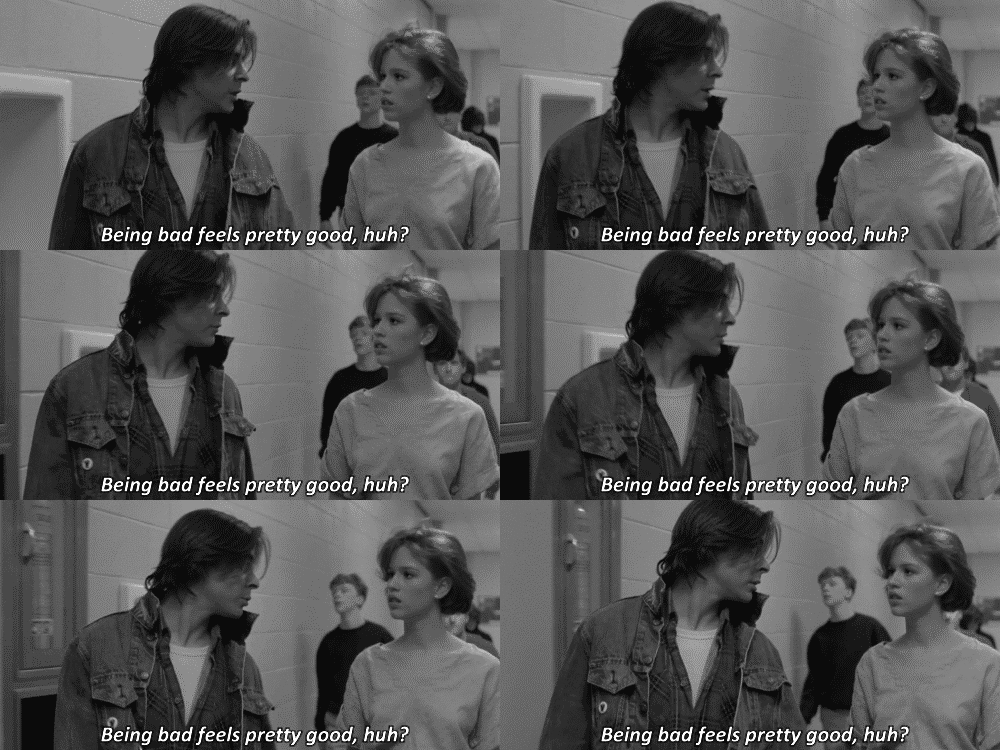
I mean, I absolutely adore The Breakfast Club and I totally ship Bender and Claire, but lately it's just been crazy how often a good girl falls for a bad boy.  I mean, seriously?!? Is that all you've got?


3. The plot.  I know it isn't true for all romance books, but it usually seems to be one of the following (similar to my point about cliches, but specifically in regard to the plot):
  • Main character hates the eventual love interest's guts, but is somehow forced into a situation where he/she is stuck with said love interest.  The two start to get to know each other and realize the other isn't as bad as they thought, and start to have feelings for one another that eventually grows into a true romantic relationship.
  • Main character pines for the love interest, but is too shy to speak up and said love interest is already in a relationship.  Said love interest eventually breaks up/is broken up with and is single, and begins to get to know guy/girl and realizes he/she the one they want to be with.
  • Main character gets the love interest of their dreams, only to lose them to someone or something.  The main character either finds a way to prove his/her love or find some new love interest who loves them back.
  • Main character is in love (or falls in love) with love interest, but something from main character or love interest's past is revealed and nothing is the same.
  • (Or something along the lines of one of mentioned plots)

4. Love triangles.  Need I say more?


What are your thoughts on romance novels?
~Alexandra

Love Triangles

Saturday, June 27, 2015
I often find myself attracted to books that have love triangles.  It is not because there are love triangles in it that draws me in, but it just happens.  I am actually not a huge fan of them; I am not completely against love triangles, but for the most part I'm not exactly a fan of them either…

I know it can be a good way to add suspense, tension and conflict in books, however I just do not see how it is really logical.  Maybe I'm just cynical because I've never been in a relationship, but to be honest, I feel like it is atypical for two people to be fighting over the same person, not a typical thing.  And it is a very typical thing these days in young adult fiction, no matter what genre.  I mean, most of these love triangle things happen in trilogies, and I do not think that two people are going to wait three books-worth of time to let the girl (or guy) decide between them, no matter how much in love they are with the person.


I mean, it's kind of pathetic and sad to watch characters pine over characters that do not love them in return… Maybe it's not that simple but what about “If you love someone, set them free. If they come back they're yours; if they don't they never were"?  Fine, I do admire the characters for trying to win their loves back, but I mean half the time its a worthless effort.  Okay, to be fair I know that the character often cares deeply or "loves both" of the love interests, but I still feel like said character always fancies one more than the other.  I know that love is a complicated thing, but the characters should not be getting themselves into situations where they are in love with two people… Once again probably not that simple, but love triangles are such cliches these days.


Why isn't it this simple?

Also, there is more to life than just love, no matter what the Beatles say (and by that, I am referring to their song "All You Need is Love").  I am far from saying that all characters stuck in love triangles are completely focused on their love lives (in fact, many have much bigger problems on their plates, like Katniss from The Hunger Games), but some are completely absorbed in their romances, and can often come across as mundane and self-absorbed because of it.


I will admit that I am probably more of a classical/scientific thinker than a romantic one, so I am taking a more "logical" or "scientific" view on a topic that is far from logical or scientific, but nonetheless, love triangles are strange phenomena that are too often found in the pages of books these days, and I felt the need to talk about it.  (The strangest thing is that I am a total sap when it comes to a good romance, yet I am extremely cynical at the same time.  Perhaps one day I'll understand…) Anyway, what are your thoughts?  Do you agree?  Disagree? I'd love to hear your thoughts!

~Alexandra